
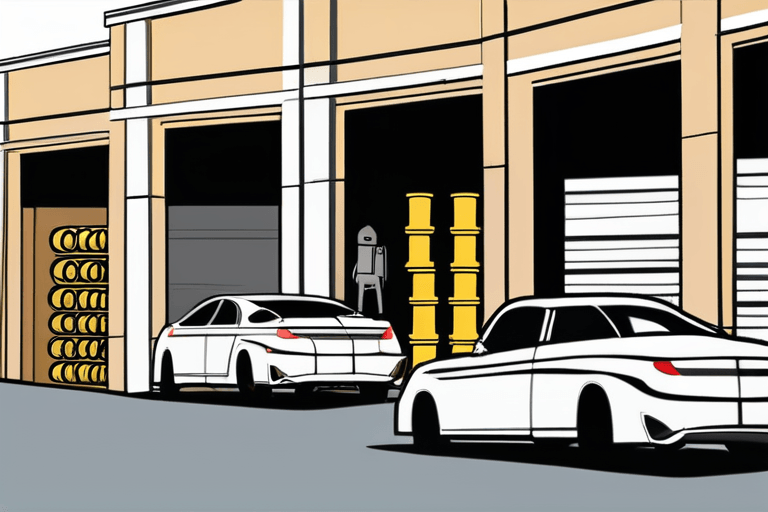
Shares in companies linked to the affected factories plummeted as the Nigerian government took swift action to address the crisis. The Nigerian government has begun cataloging the health and environmental damage caused by factories that shipped recycled lead to the United States for use in car batteries. A team of scientists arrived Tuesday in the industrial town of Ogijo, Nigeria, outside Lagos, to test the soil and air for lead. Officials have shut down recycling factories in the area and are making plans to conduct blood tests on about 500 people who live nearby.
According to Dr. Adebayo Adewole, Nigeria's Minister of Health, the government's response is one of the most aggressive campaigns to alleviate lead poisoning in the country's history. "We are taking this situation very seriously, and we will do everything in our power to protect the health and well-being of our citizens," Dr. Adewole said in a statement. Public health experts in Nigeria praised the government's swift action, citing the devastating effects of lead poisoning on the local population.
The lead poisoning crisis in Ogijo has been linked to batteries made for the world's largest automakers, including General Motors and Ford. Lead is an essential element in car batteries, and most of it now comes from recycling old batteries. The auto industry has portrayed this as an infinitely sustainable, green process. However, as The New York Times and The Examination investigation revealed, the reality is far from it. The investigation found that the recycling process is often shoddy, and the lead is frequently contaminated with other toxic substances.
The crisis in Ogijo has highlighted the dark side of the auto industry's reliance on lead recycling. While the industry has touted the process as a sustainable solution, the reality is that it often comes at a great cost to local communities. "The auto industry's obsession with profit has led to a catastrophic situation in Ogijo," said Dr. Nneoma Okoro, a public health expert at the University of Lagos. "We need to rethink our approach to lead recycling and prioritize the health and well-being of local communities."
The Nigerian government has vowed to take further action to address the crisis, including conducting a thorough investigation into the lead recycling factories and holding those responsible accountable. The government has also pledged to provide medical care and support to the affected communities. As the situation continues to unfold, one thing is clear: the crisis in Ogijo is a wake-up call for the auto industry and a reminder of the importance of prioritizing human health and the environment.
In the coming weeks, the Nigerian government will conduct blood tests on about 500 people who live nearby the affected factories. The results of these tests are expected to provide a clearer picture of the extent of the lead poisoning crisis. The government has also announced plans to establish a special task force to oversee the cleanup and rehabilitation of the affected areas. As the situation continues to evolve, one thing is certain: the people of Ogijo will not be forgotten.
Multi-Source Journalism
This article synthesizes reporting from multiple credible news sources to provide comprehensive, balanced coverage.
Share & Engage
AI Analysis
Get instant insights & analysis
More Stories
Discover more articles
No recommended articles
Check back later for more stories
Discussion
Join 0 others in the conversation
Share Your Thoughts
Your voice matters in this discussion
Login to join the conversation
No comments yet
Be the first to share your thoughts!